
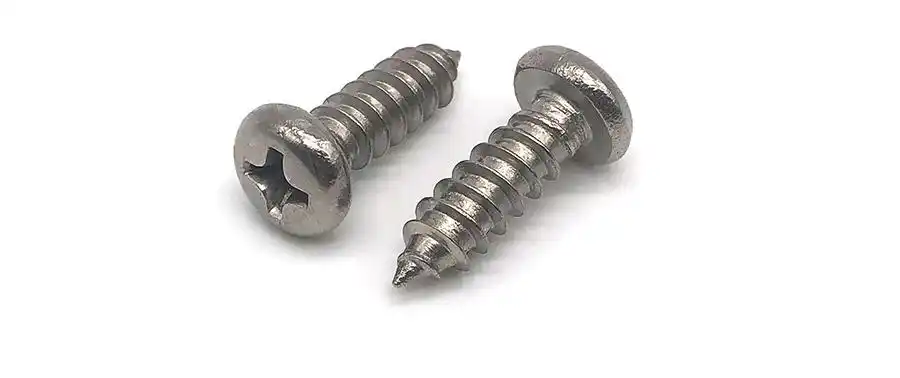
Self-tapping and self-drilling screws look similar but work differently. Choosing the wrong one slows installation or strips the joint. Here is a clear comparison.
Self-tapping screws
A self-tapping screw cuts or forms its own thread as it is driven, but it usually needs a pre-drilled pilot hole. There are two sub-types: thread-cutting (removes material, for harder metals and plastics) and thread-forming (displaces material, for softer metals). They are common in sheet metal, plastic and light assembly.
Self-drilling screws
A self-drilling screw (often called Tek screw) has a drill-bit-shaped point that drills its own hole and taps the thread in one step — no pilot hole needed. This makes them ideal for fast fastening of metal-to-metal or metal roofing and cladding.
Quick comparison
| Self-tapping | Self-drilling | |
|---|---|---|
| Pilot hole | Usually required | Not required |
| Point | Sharp or blunt thread point | Drill-bit point (with flutes) |
| Best for | Sheet metal, plastic, wood | Metal sheet, steel framing, roofing |
| Speed | Two steps (drill + drive) | One step |
How to choose
- Thin material or pre-drilled parts: self-tapping.
- Thicker metal, no pre-drilling, fast install: self-drilling.
- Match the point/drill capacity to your material thickness, and choose a corrosion finish (zinc, or A2/A4 stainless) for the environment.
Source these fasteners from Chaoshuo Trading
Chaoshuo Trading is a China-based fastener source factory supplying bolts, nuts, screws, washers, rivets, threaded rods and custom fasteners in DIN/ISO standards, with factory-direct pricing and OEM customization. Contact us for a quote: info@chaoshuotrade.com | WhatsApp +86 158 0311 9164 | www.chaoshuotrade.com