
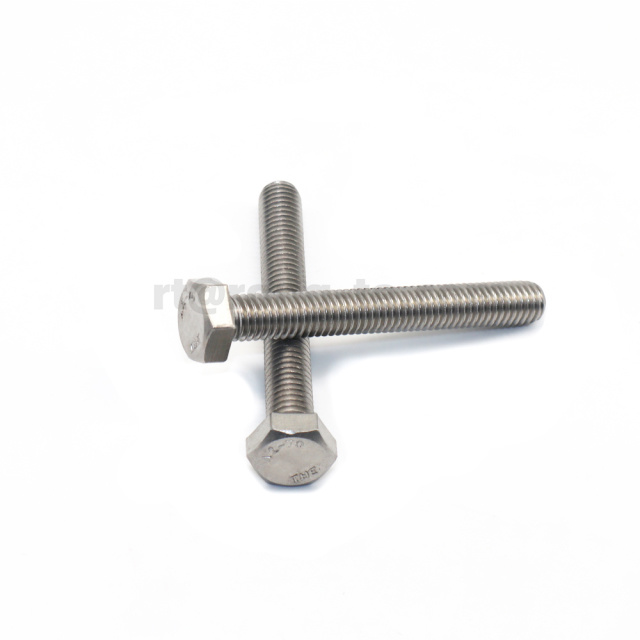
Quality fasteners must pass rigorous testing to ensure they meet specifications. This guide explains the three most important tests: tensile strength, hardness, and salt spray corrosion resistance.
Tensile Testing
The most critical test for fastener strength.
What It Measures
- Yield strength: Point where permanent deformation begins
- Ultimate tensile strength (UTS): Maximum load before fracture
- Elongation: How much the fastener stretches before breaking
- Reduction of area: Necking at fracture point
How It Works
A fastener is clamped in a universal testing machine and pulled apart at controlled speed. Load and elongation are recorded continuously until fracture.
Standards
- ISO 898-1: Carbon and alloy steel fasteners
- ISO 3506-1: Stainless steel fasteners
- ASTM A370: Steel product mechanical testing
Minimum Values by Grade
- Grade 4.8: UTS 400 MPa, Yield 320 MPa
- Grade 8.8: UTS 800 MPa, Yield 640 MPa
- Grade 10.9: UTS 1040 MPa, Yield 940 MPa
- Grade 12.9: UTS 1220 MPa, Yield 1100 MPa
Hardness Testing
Verifies material strength without destroying the fastener.
Methods
- Rockwell C (HRC): Most common for hardened fasteners. Uses diamond cone indenter.
- Vickers (HV): More precise, used for thin sections and case hardness.
- Brinell (HB): For softer materials and large grain structures.
Where to Test
For accuracy, test on the bolt head cross-section or a cross-section of the threaded portion. Surface decarburization can give false low readings.
Hardness vs. Grade
- Grade 8.8: 250-320 HV
- Grade 10.9: 320-380 HV
- Grade 12.9: 380-435 HV
Salt Spray Testing (Corrosion Resistance)
Simulates years of outdoor exposure in a controlled environment.
How It Works
Fasteners are placed in a sealed chamber and exposed to a 5% NaCl salt fog at 35°C. The test runs continuously, and fasteners are inspected at regular intervals for red rust.
Standards
- ISO 9227: Salt spray test methods
- ASTM B117: Standard salt spray test
Results by Coating
- Bare carbon steel: 2-4 hours to red rust
- Zinc plating (8 microns): 96-200 hours
- Zinc plating (12 microns): 200-500 hours
- Hot-dip galvanizing (80 microns): 2000-4000 hours
- Dacromet (6 microns): 1000-2000 hours
- Stainless steel 304: No red rust in 1000+ hours
- Stainless steel 316: No red rust in 3000+ hours
Other Important Tests
- Proof load test: Apply specified load, check for permanent set
- Impact testing: Measure toughness at low temperatures
- Fatigue testing: Cyclic loading to determine endurance limit
- Hydrogen embrittlement test: Critical for high-strength plated fasteners
- Torque-tension test: Verify friction characteristics
Documentation
Always request test certificates with your fastener orders. EN 10204 3.1 certificates include actual test values, not just “compliant” statements.
Chaoshuo Trading – Every shipment includes full test certificates. We test in-house and use accredited third-party labs for independent verification.