
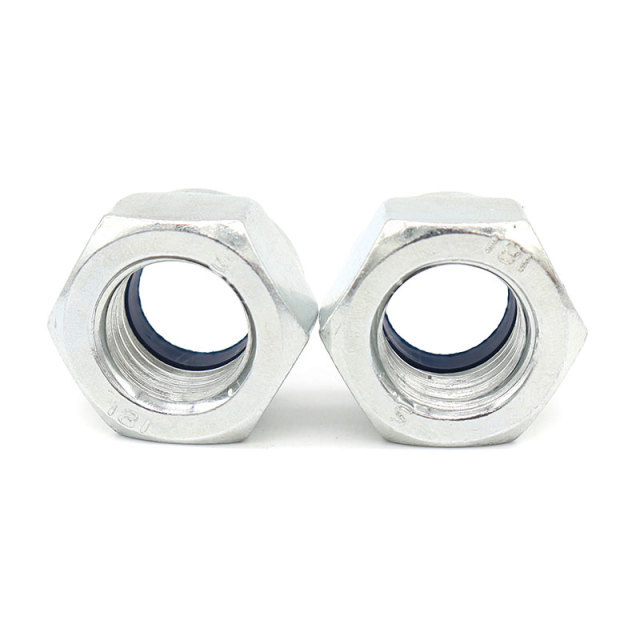
Vibration is the enemy of any bolted joint. When machinery shakes, a standard nut can slowly back off and cause failure. Lock nuts are engineered to resist this. Two of the most popular types are the nylon insert lock nut (Nyloc) and the all-metal prevailing torque lock nut. They solve the same problem in very different ways, and choosing the right one depends mostly on temperature and reuse.
How Each Lock Nut Works
A nylon insert lock nut has a nylon collar set into the top of the nut. As the nut threads onto the bolt, the bolt cuts into the softer nylon, creating friction that resists loosening. The metal threads never actually reach the nylon, so the locking action comes purely from the deformed insert gripping the bolt.
An all-metal lock nut uses a deformed or slotted metal section — often a slightly out-of-round top thread — to create prevailing torque. Because there is no plastic, the locking force comes entirely from metal-on-metal interference.
Temperature: The Deciding Factor
The nylon insert limits Nyloc nuts to roughly 100–120°C (about 250°F) for continuous service. Above that, the nylon softens and the locking force fades. All-metal lock nuts have no such limit and are used up to 300°C or higher depending on the base material and plating. If your application runs hot — exhaust systems, engines, furnaces — the all-metal nut is the only safe choice.
Comparison at a Glance
| Property | Nylon Insert (Nyloc) | All-Metal Lock Nut |
|---|---|---|
| Max temperature | ~100-120°C | 300°C+ |
| Reusability | Limited (a few times) | Better, many cycles |
| Locking source | Nylon friction | Metal interference |
| Cost | Lower | Higher |
| Chemical resistance | Lower | High |
| Best for | General, cool assemblies | High heat, heavy vibration |
Reusability and Cost
Nyloc nuts are cheaper and perfectly reliable for general assembly, but the nylon insert wears after a few installations and should be replaced once the locking feel weakens. All-metal lock nuts cost more but tolerate many more reuse cycles, which matters for maintenance-heavy equipment where nuts are removed and refitted regularly.
Which Should You Choose?
Choose Nyloc for everyday assemblies at normal temperatures — furniture, general machinery, automotive interiors, and light equipment — where cost matters and heat is not a concern. Choose an all-metal lock nut for high-temperature zones, aggressive chemical environments, or joints subject to severe vibration and frequent servicing. For safety-critical joints, always follow the torque and locking specification called out by your engineer, and never reuse a lock nut that has lost its prevailing torque.
About Chaoshuo Trading
Chaoshuo Trading is a source fastener factory in China, offering factory-direct pricing and full OEM/ODM customization on bolts, nuts, screws, washers and anchors. From standard DIN/ISO/ANSI parts to custom drawings, we manufacture to your spec with in-house quality control and export-ready packaging. Get a fast quote today:
- Email: info@chaoshuotrade.com
- WhatsApp: +86 158 0311 9164
- Website: www.chaoshuotrade.com