
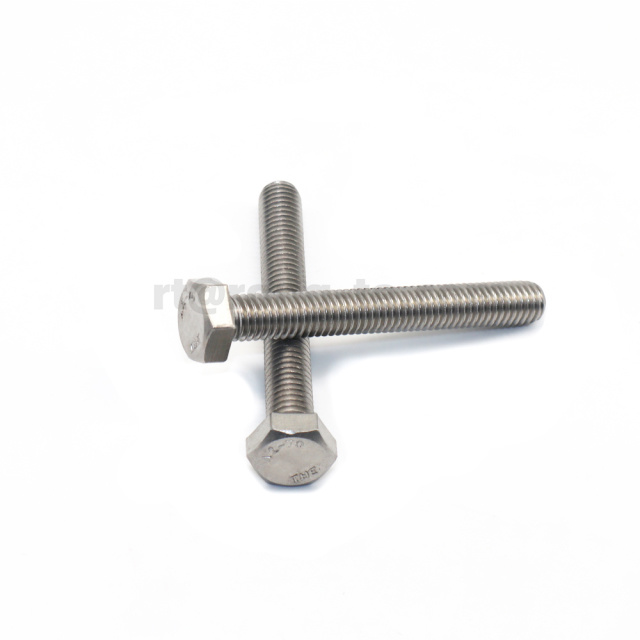
Structural bolts are the heavy-duty fasteners that hold steel-framed buildings, bridges and towers together. In North American practice, the two classic specifications are ASTM A325 and ASTM A490 (now consolidated under ASTM F3125, but still widely referenced by their original names). They look similar but differ in strength and permitted uses. This guide explains the difference for specifiers and buyers.
What Makes a Bolt “Structural”
Structural bolts are heavy hex bolts designed specifically for steel-to-steel connections in load-bearing frames. They have a shorter thread length and a thicker, heavier head than standard hex bolts, and they are installed as a matched assembly with a heavy hex nut and hardened washers. Connections are tightened to create either a bearing-type or slip-critical joint.
ASTM A325 Bolts
A325 bolts are medium-carbon or medium-carbon alloy steel, quenched and tempered, with a minimum tensile strength around 120 ksi (about 830 MPa) for common diameters. They are the workhorse of structural steel connections — strong, economical, and available galvanized for outdoor and corrosive exposure. Most everyday building frames use A325.
ASTM A490 Bolts
A490 bolts are alloy steel, quenched and tempered to a higher minimum tensile strength of about 150 ksi (roughly 1040 MPa). They carry more load per bolt, allowing fewer or smaller bolts in high-demand connections such as bridges and heavy industrial structures. Because of their higher hardness, A490 bolts have stricter rules — notably, hot-dip galvanizing is generally not permitted due to hydrogen embrittlement risk.
Comparison Table
| Property | A325 | A490 |
|---|---|---|
| Material | Medium carbon / alloy | Alloy steel |
| Min. tensile | ~120 ksi (830 MPa) | ~150 ksi (1040 MPa) |
| Hot-dip galvanizing | Allowed | Not permitted |
| Typical use | Buildings, general steel | Bridges, heavy structures |
| Metric equivalent | ~Grade 8.8 | ~Grade 10.9 |
Installation and Tension
Structural bolts must be tensioned correctly to perform. Common methods include turn-of-nut, calibrated wrench, tension-control (TC) bolts, and direct-tension-indicator (DTI) washers. Slip-critical connections rely on the clamping force between plates, so achieving proper pretension is essential — under-tensioned structural bolts can allow the joint to slip under load.
Which Should You Specify?
Use A325 (or its metric Grade 8.8 equivalent) for the majority of building steelwork where its strength is more than adequate and galvanizing may be needed. Reserve A490 (metric 10.9) for high-load connections where reducing bolt count or size is worthwhile, and account for its coating restrictions. Always follow the connection design and pretension method specified by the structural engineer, and source bolts, nuts and washers as matched, certified assemblies.
About Chaoshuo Trading
Chaoshuo Trading is a source fastener factory in China, offering factory-direct pricing and full OEM/ODM customization on bolts, nuts, screws, washers and anchors. From standard DIN/ISO/ANSI parts to custom drawings, we manufacture to your spec with in-house quality control and export-ready packaging. Get a fast quote today:
- Email: info@chaoshuotrade.com
- WhatsApp: +86 158 0311 9164
- Website: www.chaoshuotrade.com