
Solar Mounting Fasteners: What You Need to Know
Complete guide to fasteners used in solar panel mounting systems. Learn about materials, specifications, corrosion resistance, and how to choose the right fasteners for solar installations.
Why Solar Fasteners Matter
Solar panel installations face unique challenges:
- `n
- 25+ year outdoor exposure
- Extreme weather (wind, snow, UV, temperature swings)
- Corrosive environments (coastal, industrial, agricultural)
- Critical structural integrity (panels must stay secure)
- Difficult maintenance (replacements are expensive and dangerous)
`nUsing the wrong fasteners can lead to:
- `n
- Panel detachment in high winds
- Structural failure under snow loads
- Corrosion and staining
- Electrical grounding issues
- Costly repairs and liability
`n
Types of Solar Mounting Fasteners
1. Solar Bolt (Flange Bolt)
Description: Hex bolt with integrated flange, specifically designed for solar mounting.
Common sizes:
- `n
- M8 × 16, 20, 25, 30mm
- M10 × 20, 25, 30, 35mm
`nFeatures:
- `n
- Serrated flange (bites into aluminum to prevent loosening)
- Often made of stainless steel or carbon steel with special coating
- Self-locking design (eliminates need for separate lock washer)
`nBest for:
- `n
- Panel frame to rail connections
- Rail to bracket connections
- General solar structure assembly
`n
2. Solar Hook Bolt (T-Bolt)
Description: T-shaped bolt designed to slide into aluminum rail channels.
Common sizes:
- `n
- M8 × 20, 25, 30mm
- M10 × 25, 30, 35mm
`nFeatures:
- `n
- T-head slides into rail T-slot
- Quarter-turn to lock
- Allows adjustable positioning
- High pull-out resistance
`nBest for:
- `n
- Panel clamp to rail connections
- Adjustable mounting points
- Modular mounting systems
`n
3. Solar Panel Clamp (Mid Clamp & End Clamp)
Description: Aluminum or stainless steel clamps that secure panels to rails without drilling.
Types:
- `n
- Mid clamp: Holds two adjacent panels together
- End clamp: Secures panel edge to rail
`nFeatures:
- `n
- EPDM rubber insert (protects panel frame, provides grip)
- Stainless steel or anodized aluminum
- Pre-assembled for fast installation
`nBest for:
- `n
- Securing solar panels to mounting rails
- Non-penetrating attachment
- Quick installation
`n
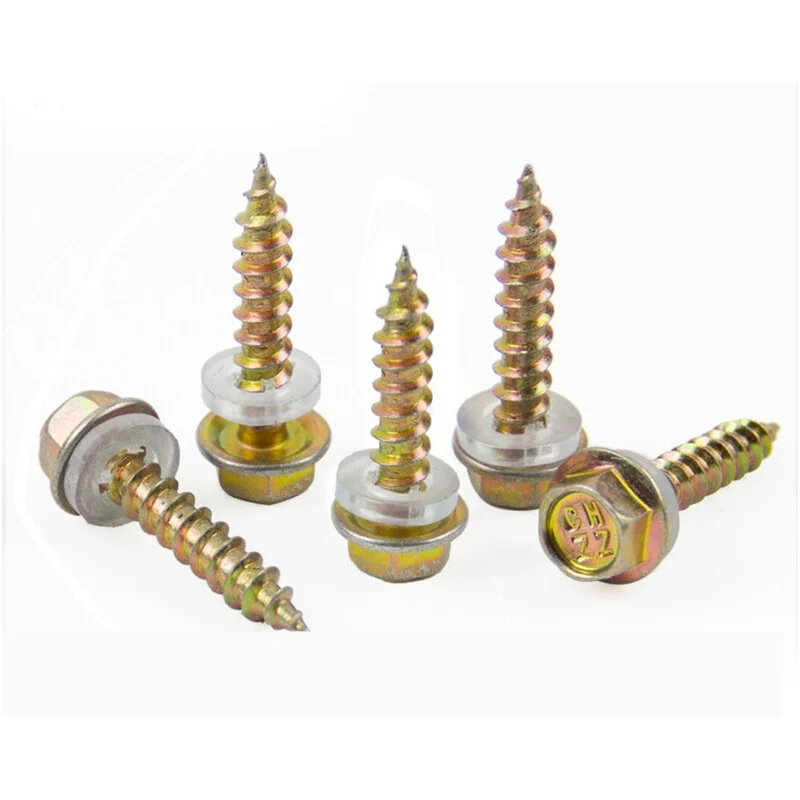
4. Lag Screw (Wood Screw)
Description: Large wood screw for attaching mounting brackets to wooden rafters.
Common sizes:
- `n
- M8 × 80, 100, 120mm
- M10 × 100, 120, 150mm
`nFeatures:
- `n
- Coarse threads for wood grip
- Often stainless steel or hot-dip galvanized
- Sealed with rubber washer (waterproof)
`nBest for:
- `n
- Roof mount attachments to wood rafters
- Pergola and carport installations
- Wooden structure mounting
`n
5. Foundation Bolt (Anchor Bolt)
Description: Cast-in-place or post-installed anchor bolt for ground mount systems.
Common sizes:
- `n
- M12 × 300, 400, 500mm
- M16 × 400, 500, 600mm
- M20 × 500, 600, 800mm
`nFeatures:
- `n
- Hot-dip galvanized for underground use
- L-bolt, J-bolt, or headed bolt
- Embedded in concrete foundation
`nBest for:
- `n
- Ground mount systems
- Carport and canopy structures
- Large commercial installations
`n
6. Self-Drilling Screw (Tek Screw)
Description: Screw with drill point that creates its own hole in metal.
Common sizes:
- `n
- #10, #12, 1/4″ diameter
- Lengths: 1″, 1.5″, 2″, 3″
`nFeatures:
- `n
- No pre-drilling required
- Hex washer head (for high torque)
- Sealing washer (waterproof)
- Various head styles (hex, pan, truss)
`nBest for:
- `n
- Metal roof attachments
- Steel purlin connections
- Light gauge steel framing
`n
Material Selection for Solar Fasteners
Stainless Steel (Recommended)
Grades:
- `n
- A2-70 (304): General solar applications, inland installations
- A4-80 (316): Coastal, marine, industrial, or chemical environments
`nAdvantages:
✅ Excellent corrosion resistance (25+ years)
✅ No coating to wear off
✅ Strong and durable
✅ Low maintenance
✅ Compatible with aluminum (no galvanic corrosion)
Disadvantages:
❌ Higher cost (3-5x carbon steel)
❌ Lower strength than high-grade carbon steel
❌ Galling risk during installation
Best for:
- `n
- All residential and commercial solar
- Coastal installations (use A4/316)
- Long-term reliability priority
`n
Hot-Dip Galvanized Carbon Steel
Specifications:
- `n
- Grade 8.8 or higher
- Coating thickness: 45-85 μm
- Salt spray resistance: 500+ hours
`nAdvantages:
✅ Lower cost than stainless
✅ Good corrosion resistance (20-30 years)
✅ High strength (Grade 8.8, 10.9)
✅ Widely available
Disadvantages:
❌ Coating can wear over time
❌ Not suitable for coastal environments
❌ May stain aluminum (galvanic corrosion)
❌ Thread fit issues (oversized tapping needed)
Best for:
- `n
- Budget-conscious projects
- Inland installations
- Ground mount foundations
- Non-critical structural connections
`n
Dacromet Coated Carbon Steel
Specifications:
- `n
- Grade 8.8 or 10.9
- Zinc flake coating
- Salt spray resistance: 1000+ hours
`nAdvantages:
✅ Excellent corrosion resistance (better than HDG)
✅ No hydrogen embrittlement risk
✅ Thin coating (good thread fit)
✅ Uniform appearance
Disadvantages:
❌ Higher cost than HDG
❌ Specialized application
❌ Less common than stainless
Best for:
- `n
- High-strength connections
- Automotive-integrated solar
- Premium mounting systems
`n
Aluminum (Anodized)
Specifications:
- `n
- 6000 series aluminum (6061-T6, 6063-T5)
- Anodized coating: 15-25 μm
`nAdvantages:
✅ Lightweight
✅ Excellent corrosion resistance
✅ Compatible with aluminum rails (no galvanic issues)
✅ Attractive appearance
Disadvantages:
❌ Lower strength than steel
❌ More expensive than carbon steel
❌ Not suitable for high-load connections
Best for:
- `n
- Panel clamps
- Rail components
- Non-structural fasteners
`n
Corrosion Resistance Requirements
Environmental Categories
| Environment | Description | Recommended Material |
|————-|————-|———————|
| C1 (Very low) | Indoor, dry | Carbon steel, zinc plated |
| C2 (Low) | Rural, indoor condensation | Carbon steel, HDG |
| C3 (Medium) | Urban, light industrial | A2 stainless or HDG |
| C4 (High) | Industrial, coastal inland | A2 stainless (304) |
| C5 (Very high) | Coastal, marine, chemical | A4 stainless (316) |
| Environment | Description | Recommended Material |
| ————- | ————- | ——————— |
| C1 (Very low) | Indoor, dry | Carbon steel, zinc plated |
| C2 (Low) | Rural, indoor condensation | Carbon steel, HDG |
| C3 (Medium) | Urban, light industrial | A2 stainless or HDG |
| C4 (High) | Industrial, coastal inland | A2 stainless (304) |
| C5 (Very high) | Coastal, marine, chemical | A4 stainless (316) |
| CX (Extreme) | Offshore, heavy industrial | A4 stainless (316) or specialized |
Solar-Specific Recommendations
Residential rooftop (inland):
- `n
- A2-70 (304) stainless steel
- Or HDG carbon steel (budget option)
`nResidential rooftop (coastal, <5km from sea):
- `n
- A4-80 (316) stainless steel (mandatory)
`nCommercial ground mount:
- `n
- A2 stainless for above-ground
- HDG for foundations and underground
`nIndustrial rooftop (chemical exposure):
- `n
- A4 stainless steel
- Or Dacromet coated carbon steel
`nFloating solar (water exposure):
- `n
- A4-80 (316) stainless steel (mandatory)
- Enhanced sealing and waterproofing
`n
Installation Best Practices
Torque Specifications
| Bolt Size | Grade | Torque (N·m) | Notes |
|———–|——-|————–|——-|
| M6 | A2-70 | 5-6 | Stainless, lubricated |
| M8 | A2-70 | 12-14 | Stainless, lubricated |
| M8 | 8.8 | 20-25 | Carbon steel |
| M10 | A2-70 | 24-28 | Stainless, lubricated |
| Bolt Size | Grade | Torque (N·m) | Notes |
| ———– | ——- | ————– | ——- |
| M6 | A2-70 | 5-6 | Stainless, lubricated |
| M8 | A2-70 | 12-14 | Stainless, lubricated |
| M8 | 8.8 | 20-25 | Carbon steel |
| M10 | A2-70 | 24-28 | Stainless, lubricated |
| M10 | 8.8 | 40-50 | Carbon steel |
Important:
- `n
- Always use calibrated torque wrench
- Apply anti-seize compound to stainless steel threads
- Follow manufacturer specifications
- Re-check torque after 24 hours (relaxation)
`n
Preventing Galvanic Corrosion
Problem: When dissimilar metals contact in presence of electrolyte (rain, condensation), the less noble metal corrodes rapidly.
Common combinations to avoid:
- `n
- ❌ Stainless steel bolt + aluminum rail (without isolation)
- ❌ Carbon steel bolt + aluminum rail (severe corrosion)
- ❌ Copper + aluminum (very severe)
`nSolutions:
✅ Use compatible materials (stainless + stainless, aluminum + aluminum)
✅ Isolate dissimilar metals with plastic washers/sleeves
✅ Apply anti-corrosion compound (zinc-rich paste)
✅ Use stainless steel fasteners with aluminum (acceptable with proper design)
Sealing and Waterproofing
Critical areas:
- `n
- Roof penetrations (lag screws, flashing)
- Rail end caps
- Junction box connections
`nBest practices:
- `n
- Use EPDM or silicone washers
- Apply sealant (polyurethane or silicone)
- Install flashing correctly
- Inspect seals annually
`n
Wind Load Considerations
Fastener Spacing Guidelines
| Wind Zone | Panel Spacing | Fastener Points | Bolt Size |
|———–|—————|—————–|———–|
| Low (<100 km/h) | Standard | 4 per panel | M8 |
| Medium (100-150 km/h) | Reduced | 6 per panel | M8 or M10 |
| High (150-200 km/h) | Close | 8 per panel | M10 |
| Wind Zone | Panel Spacing | Fastener Points | Bolt Size |
| ———– | ————— | —————– | ———– |
| Low (<100 km/h) | Standard | 4 per panel | M8 |
| Medium (100-150 km/h) | Reduced | 6 per panel | M8 or M10 |
| High (150-200 km/h) | Close | 8 per panel | M10 |
| Extreme (>200 km/h) | Special | 8+ per panel | M10 or M12 |
Note: Always follow structural engineer’s specifications for your specific location and installation.
Pull-Out Resistance
Lag screws in wood (typical values):
| Size | Embedment | Pull-Out (softwood) | Pull-Out (hardwood) |
|——|———–|———————|———————|
| M8 × 80mm | 60mm | 800 kg | 1,200 kg |
| M8 × 100mm | 80mm | 1,000 kg | 1,500 kg |
| M10 × 100mm | 80mm | 1,200 kg | 1,800 kg |
| Size | Embedment | Pull-Out (softwood) | Pull-Out (hardwood) |
| —— | ———– | ——————— | ——————— |
| M8 × 80mm | 60mm | 800 kg | 1,200 kg |
| M8 × 100mm | 80mm | 1,000 kg | 1,500 kg |
| M10 × 100mm | 80mm | 1,200 kg | 1,800 kg |
| M10 × 120mm | 100mm | 1,500 kg | 2,200 kg |
Safety factor: Use minimum 4:1 for wind loads (working load = 1/4 of ultimate).
Quality Testing and Certification
Required Tests
| Test | Standard | Frequency | Purpose |
|——|———-|———–|———|
| Tensile strength | ISO 898-1 | Every batch | Verify grade |
| Salt spray test | ISO 9227 | Annual | Corrosion resistance |
| Coating thickness | ISO 2808 | Every batch | Coating quality |
| Thread gauge | ISO 1502 | Every batch | Thread quality |
| Test | Standard | Frequency | Purpose |
| —— | ———- | ———– | ——— |
| Tensile strength | ISO 898-1 | Every batch | Verify grade |
| Salt spray test | ISO 9227 | Annual | Corrosion resistance |
| Coating thickness | ISO 2808 | Every batch | Coating quality |
| Thread gauge | ISO 1502 | Every batch | Thread quality |
| Hardness test | ISO 6508 | Every batch | Material properties |
Certifications to Request
- `n
- Mill test certificate (MTC) — Material composition and mechanical properties
- Salt spray test report — Corrosion resistance verification
- ISO 9001 — Quality management system
- TÜV/SGS/BV inspection — Third-party quality verification
`n
Common Mistakes to Avoid
- `n
- Using carbon steel in coastal areas — Will corrode within 2-5 years
- Mixing metals without isolation — Galvanic corrosion
- Under-torquing stainless steel — Galling and joint loosening
- Over-torquing — Stripping threads, especially in aluminum
- Skipping waterproofing — Roof leaks cause major damage
- Using wrong bolt length — Insufficient thread engagement
- Not using lock features — Vibration loosens standard nuts
- Ignoring wind load — Panels can detach in storms
- Cheap fasteners — Saves $100, costs $10,000 in repairs
- No maintenance plan — Inspect and re-torque annually
`n
Frequently Asked Questions
Q: Can I use regular bolts for solar panels?
A: You can, but it’s not recommended. Solar-specific bolts have features like serrated flanges, self-locking, and proper corrosion resistance. Regular bolts may loosen or corrode prematurely.
Q: How long should solar fasteners last?
A: Quality stainless steel fasteners should last 25+ years (matching panel lifespan). Hot-dip galvanized should last 20-30 years in inland environments. Avoid carbon steel with thin coatings.
Q: Do I need stainless steel for inland installations?
A: Not mandatory, but highly recommended. A2-70 (304) stainless is the industry standard for all solar installations. HDG carbon steel is acceptable for budget projects in dry, inland areas.
Q: What’s the difference between mid clamp and end clamp?
A: Mid clamps hold two adjacent panels together (between panels). End clamps secure the panel edge to the rail (at panel ends). Both are needed for complete installation.
Q: Can I reuse solar fasteners?
A: Stainless steel bolts can be reused if threads are undamaged. Nylon lock nuts should not be reused. Always inspect and replace if in doubt.
Q: How do I prevent stainless steel bolts from seizing?
A: Use anti-seize compound (nickel-based or copper-based), install slowly, and avoid power tools for final tightening. Hand-tighten with torque wrench.
Need Solar Mounting Fasteners?
Chaoshuo Trading supplies complete solar fastener solutions:
- `n
- Solar bolts: M8-M10, A2-70/A4-80 stainless
- Hook bolts: T-bolts for rail systems
- Panel clamps: Mid and end clamps with EPDM
- Lag screws: M8-M10, various lengths
- Foundation bolts: M12-M20, HDG for ground mounts
- Custom solutions: Non-standard per drawing
`nFactory direct pricing, global shipping
Get a free quote: Contact Us →
Related guides: Surface Treatment Guide | Stainless Steel vs Carbon Steel